Most people start a bathroom renovation thinking about tiles, tapware and vanities. The shower screen gets chosen last, often from a catalogue, without much deliberation. That is a mistake. The shower screen covers a large portion of your bathroom wall. It sets the visual tone for the whole space. Choose the wrong type and even the most expensive tiles look wrong.
Beyond aesthetics, the frame type affects how easy the screen is to clean, how long it lasts, how much light passes through, and whether the space feels open or enclosed. Getting this decision right is worth fifteen minutes of reading.
A full framed shower screen uses an aluminium profile around every edge of the glass. The frame holds the glass rigid, distributes load across the entire perimeter, and creates a seal that keeps water where it belongs.
Full framed screens are the most robust option for high-traffic family bathrooms. If your household has young children who treat the shower door as a toy, or a pattern of frequent, energetic use, full framed is the choice. The aluminium frame absorbs impacts that would stress a frameless hinge system over time.
They are also the most budget-friendly option. If cost is the primary constraint and the bathroom is purely functional, a well-made full framed screen in a quality finish does its job without compromise.
The frame collects soap scum, hard water deposits and mould at the seal lines. In a bathroom that does not get daily cleaning attention, the frame becomes the most maintenance-intensive part of the room. The profile also reduces light transmission, which can make smaller bathrooms feel more enclosed than they are.
Harbour Glass supplies full framed screens in Chrome, Matte Black, Brushed Nickel, and Gold. These cover the vast majority of design directions in Australian bathrooms.
The semi-frameless screen is the most popular shower screen we install. It sits between framed and frameless in price, visual weight, and maintenance requirements, and it hits a sweet spot that suits the majority of renovations.
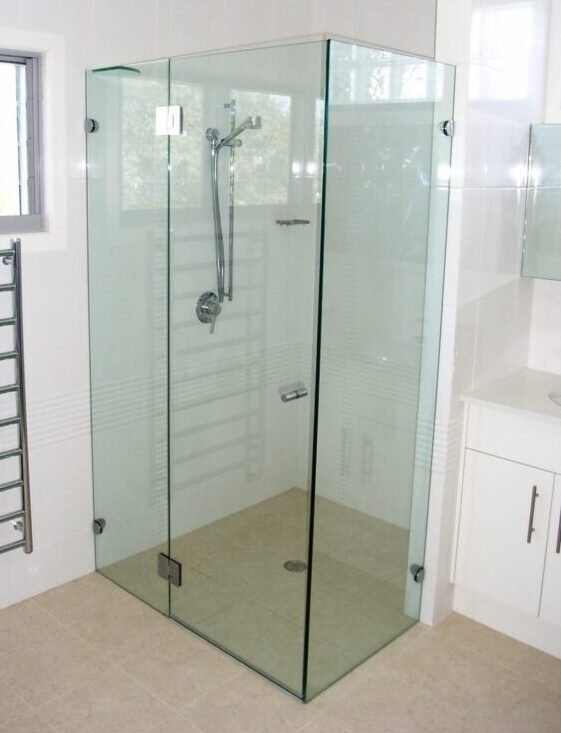
A slimline aluminium channel runs around the outer perimeter of the screen assembly. All internal glass-to-glass connections are frameless. The result is a screen that looks considerably more open and premium than a fully framed alternative, while the perimeter profile handles the structural load more forgivingly than a pure frameless system.
Semi-frameless is the go-to choice for renovation projects where the bathroom is a significant but not unlimited investment, and where the goal is an upmarket result that reads as frameless from the main sight lines. It works in alcove, corner, and walk-in configurations equally well. It is also more tolerant of walls that are not perfectly plumb, which matters in older homes on the Coffs Coast where renders settle over time.
The perimeter seal still requires attention, but there is far less frame surface than a full framed screen. A semi-frameless screen with quality hardware and a proper squeegee habit after each use will look pristine for well over a decade with no significant maintenance.
No aluminium. No perimeter profile. Just heavy glass, precision-engineered hardware, and the engineering to make it work. A properly installed frameless shower screen is the cleanest, most open, and most durable shower screen you can buy.
Frameless screens use a minimum of 10mm toughened glass, compared to 4-6mm in framed applications. The thickness is not about aesthetics, although it does look exceptional. It is structural. The glass panel itself is load-bearing, supported by precision-fitted hinges, wall channels, and pivot systems designed to handle the weight of the panel without deformation over years of daily use.
Every frameless installation by Harbour Glass is individually templated. We measure your bathroom, not a catalogue. Tolerances in the construction industry are never perfect, and frameless glass is unforgiving of sloppiness. Our experience over almost 19 years means we know where the problems hide.
If you have a small bathroom and you want it to feel bigger without physically changing anything, a frameless shower screen is the single most effective upgrade available. Glass allows light to travel uninterrupted across the full floor area. The eye reads a continuous space rather than a divided one. Combined with a white or pale glass splashback inside the shower recess, the effect is dramatic.
This is why frameless shower screens are almost universally specified in high-end bathroom renovations regardless of bathroom size. When the glaziers near you install a frameless screen correctly, the room looks twice the size it was the day before.
There is no frame to accumulate soap scum. There are no seal lines to grow mould. Cleaning is a squeegee and a microfibre cloth. That is genuinely it. For households where bathroom cleaning is a point of friction, the cleaning advantage of frameless over framed is substantial over the lifetime of the screen.
Many Coffs Coast homeowners spend months choosing their tiles and less than thirty minutes choosing their shower hardware. The hardware finish is the jewellery of the bathroom. It ties the shower screen to the tapware, the vanity handles, and the towel rails. Getting it wrong means everything looks close but not quite right.
Harbour Glass offers 16 frameless shower hardware finishes — the widest selection on the Coffs Coast. No other local glazier comes close to this range. Most competitors offer four to six options.
| Finish Category | Available Options |
|---|---|
| Brass & Gold Tones | Antique Brass, Raw Brushed Brass, Brushed Brass, Brushed Rose Gold, Soft Gold Brushed, Polished Gold, Polished Rose Gold, Polished Brass |
| Dark & Gunmetal | Brushed Gun Metal, Matte Black, Matte Chrome |
| Nickel & Chrome | Polished Chrome, Satin Nickel, Satin Chrome, Polished Nickel |
| White | White |
The current trend on the Coffs Coast is strongly towards Matte Black and Brushed Brass for contemporary bathrooms, and Brushed Nickel for coastal and Hamptons-influenced schemes.
| Factor | Framed | Semi-Frameless | Frameless |
|---|---|---|---|
| Visual Weight | Heavy | Moderate | Minimal |
| Best For | Family bathrooms, budget renovations | Most renovations, mid-range budgets | Premium renovations, small bathrooms |
| Maintenance | Higher (frame seals) | Moderate (perimeter only) | Lowest (no frame seals) |
| Glass Thickness | 4-6mm | 6-8mm | 10mm minimum |
| Light Transmission | Reduced by frame | Good | Excellent |
| Impact on Room Size | Neutral or negative | Positive | Significantly positive |
| Longevity | Good | Very good | Excellent |
Every shower screen type is available in the three main configurations, each suited to different bathroom layouts.
An alcove shower sits between three walls. It typically requires a single hinged or sliding door panel. This is the most common configuration in standard Australian bathrooms. All three frame types work in alcove configurations.
Corner showers use two glass panels meeting at a right angle. In frameless configurations this glass-to-glass corner is handled with a precision-fitted clamp and return panel. It is visually striking and technically demanding. Our 19 years of frameless installation experience is most apparent in the accuracy of our corner fits.
Walk-in shower designs use a fixed glass panel or panels to deflect water, with no door. This is the premium contemporary choice for master bathrooms. Walk-ins are always frameless — the absence of a door makes the frame type irrelevant for framed or semi-frameless configurations.
Every shower screen we make is custom measured and manufactured to your bathroom’s exact dimensions. We do not sell off-the-shelf screens that get cut down to fit. The process runs from initial measure through to fabrication and installation in approximately five to seven business days for most standard configurations.
Yes. Frameless shower screens are installed after tiling is complete. The glass clips directly into wall channels or hardware fixed to the wall behind the tiles. Your existing tiling is unaffected.
Most standard frameless configurations work from 2.1m ceiling height upward. For lower ceilings, a fixed glass panel over the door is typically omitted. We assess this at the measure stage.
Yes. Semi-frameless and framed screens are commonly installed in investment properties as part of bathroom upgrades. We work with property investors, builders, and cabinet makers across the Coffs Coast regularly.
A squeegee after each use removes the majority of water and mineral deposits. A fortnightly clean with a non-abrasive glass cleaner keeps the surface clear. Avoid abrasive pads or acidic cleaners, which can damage glass coatings and hardware finishes over time.